Monday, March 26, 2012

Sustainable Building and Ecological Intelligence


Recently in class we have been focusing on sustainable building. Sustainability is not just about energy efficiency, it involves the conversation of our many resources and preserving healthy lives and a healthy planet. Maurice Strong, well renowned global environmentalist and previously Executive Director of the United Nations Environmental Program (UNEP) once stated:  

            After all, sustainability means running the global environment - Earth Inc. - like a corporation: with depreciation, amortization and maintenance accounts. In other words, keeping the asset whole, rather than undermining your natural capital.” (Strong) http://www.betterworldheroes.com/pages-s/strong-quotes.htm

Today there is an ever more global movement towards the sustainability of our planet and living green. Although green is many times abused as a marketing strategy for companies, I feel as though there is great importance in becoming a more sustainable planet. Being sustainable involves everything from the air we breathe to the amount of utilities we use, and the conscious efforts we make to allocate our natural resources to provide for most efficient use. Although we have seen this green movement affect every aspect of our lives down to the marketing of the products we buy, one industry making a major impact in the sustainability of our planet is the housing and construction industry. They are implementing many innovations including:
  • Passive solar heat through energy efficient windows
  • Compact fluorescent and LED light bulbs which are far more efficient 
  • The use of grey water
  • Using recycled materials 
  • Better insulation
  • More efficiency building materials including "earthpack"
  • The use of not only efficient HVAC systems, but the additional use of air ventilation systems. There is a lot of indoor air pollution in our homes.
  • The use of building materials which are "low in off gases" and and other dangerous air pollutants such as Volatile Organic Compounds.
Daniel Goleman, Industrial Ecologist and author of "Ecological Intelligence", stated that there needs to be a mass movement to utilize these practices and work toward 100% sustainability throughout the entire supply chain, because although these products allow for more sustainability, any product that has had a long chain of supply through manufacturers is not in fact 100% sustainable. Goleman, Daniel. Ecological Intelligence: the Hidden Impacts of What We Buy. New York: Broadway, 2010. Print. Goleman stated that even to make t shirts of "100% organic cotton", dangerous pesticides are used which consist of chlorinated hydrocarbons. He explains that we need a mass movement toward sustainability for all manufacturers and work toward developing a sustainable globe. I agree with Daniel Goleman in that we should be working toward a sustainable planet. Although his vision is ideal, I do not think that it is easily feasible in a timely manner. I think that we should implement more sustainable practices in our manufacturing industry just as the construction industry has been doing. So that one day we can all work toward a more sustainable planet.


Monday, March 19, 2012

Week 9- Transportation-Related Challenges


In Ralph Buehler’s article “Determinants of Transport Mode Choice: A Comparison of Germany and the USA” published in the Journal of Transport Geography, the author addresses the motorization rates in Germany and the US. Studies show that Germans make a four times higher share of trips using “green” methods of transportation (walking, biking, etc.) Delving deeper into the issue to discover why this may be, Buehler discovers that a lack of biking and walking friendly paths may be part of the issue. Many destinations in the US are accessible only by car, forcing many to drive. In addition to this problem, gas taxes and registration fees are lower in the US than they are in Germany, reducing incentive for Americans to use green methods of transportation. Also, parking is cheap and generally readily available, and road construction and maintenance are subsidized at a higher rate. These aspects present a significant obstacle for the US in reducing vehicle-related greenhouse gas emissions that contribute to global warming.

In an article published in Time: Moneyland magazine, author Brad Tuttle discusses the gap between Germans and Americans (http://moneyland.time.com/2010/09/27/why-you-should-behave-less-like-an-american-and-more-like-a-german/). He believes the gap is due to cultural differences. I find this to be an interesting thesis. While I agree with Buehler in the aforementioned article, I also think the dramatic difference between the transportation choices made by Germans versus Americans is partly behavioral. The way we are raised plays a large role in the choices we will make for the rest of our lives. For instance, if we are raised by parents in an area where we can walk to places like school, the grocery store, and shops, we are likely to develop the same habits and continue to do so, if possible. But unfortunately, most Americans are raised in suburban towns plagued by urban sprawl that force them to be very auto-dependent.

With all that being said, the issue at hand is a serious one that needs feasible solutions now. The first step for the US is creating the infrastructure for walking and cycling so that people can choose to use these green methods of transportation if they desire. Other regulations like increasing incentive to walk or bike, can then be proposed. Portland, Oregon is very pedestrian friendly, and can be used as a model for other cities to add the proper infrastructure for walking and cycling.


Monday, March 12, 2012

Safer Roadways and the Elderly


The issue of elderly drivers in America is a controversial one. The issue of accidents caused by the elderly has sparked many plans to counteract their lessened physical capabilities including having the elderly renew their driver’s license at the DMV every few years. Some have gone as far as proposing a maximum driving age – similar to the minimum legal age to drive. So far neither of these concepts have been widespread, instead city planners have focused on making their roadways safer to prepare for lesser drivers.
It has been documented that less accidents occur on highways and interstate roads. Due to this, in his article at http://www.pps.org/blog/wider-straighter-and-faster-not-the-solution-for-older-drivers/, Gary Toth states that city planners have been trying to emulate highways since 1966 in order to reduce accidents. Planners have been making roads straighter and wider like highways. Unfortunately, this has proved counterproductive, as these new roads invoke drivers to speed unnecessarily and cause an increase in accidents. While higher speeds are not as detrimental on interstates, in pedestrian areas with lots of intersections this has demonstrated poorly.
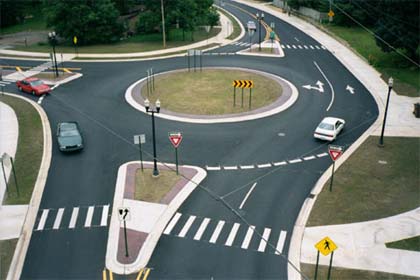
            What cities have been doing has proven ineffective, and new measurements are needed. New plans call for courses that naturally reduce the speed limit. The elderly are at much less risk to themselves and others when they, and other drivers, are driving at a slower speed. At a slower speed, everyone has more time to react. Other plans of action such as roundabouts can greatly reduce fatalities and major injuries. 

Friday, February 24, 2012

Crawford and Squares

J.H. Crawford writes about the evolution of street layouts in “A Brief History of Urban Form”. He highlights how much the pattern of a street in an urban area affects the urban world in its entirety. Urban planning relies heavily on the form roads and streets take throughout a space. Crawford takes an approach to form by writing that grid-like patterns are not as exciting or fulfilling as curved, unplanned, and beaten patterns are.
Crawford also mentions a few external factors that can affect the form of streets and roads. Some of these factors include military movement, parks, and pushes from movements such as modernism. I believe the most influential factor affecting the construction and planning of roads is the presence of already existing sites. By sites I mean attractions, venues, landscape, etc.
One example of a “site” would be a plaza. Spanish cities used the plaza for multiple purposes such as markets, meeting places for emergencies, and for celebration. The entire city, including the geometric layout of roads, would be based on the location of the plaza. Plazas have now been created as the centerpiece of cities all over the world, including the United States.
Below is a link for a site titled “The World’s Best Squares”, which shows and describes some of the most useful center squares in the world. The site also offers images of other important sites like downtowns, parks, and waterfronts.


Above is a photo of a plaza in Genova, Italy. From Wikipedia

Monday, February 20, 2012

The Right to the City "Urban Advantage"

The “right to the city” concept has been put to use to varying degrees of success over the past half-century, although some countries have ignored or spurned it altogether. It must not be viewed as a new legal instrument, but instead subsumes a wide range of universally recognized human rights into a single claim for enforcement in urban areas. Many cities in the developing world devise and enforce inclusive policies that abide by national and international commitments without any explicit reference to the “right to the city.” Whether they formally endorse the “right to the city” or not, many municipal authorities are institutionally ill-equipped to make this right effective, including when it comes to coordination with national and state/provincial government. It has been applied as a theoretical, political, conceptual framework that refers to such aspects as enforcement, empowerment, participation, self-realization, self-determination, and different forms of protection of existing human rights at the city level. The "right to the city” remains a powerful vehicle for social change that warrants serious consideration. The "right to the city” should be viewed as an expression of the deep yearnings of urban dwellers to see their multiple humans’ rights become more effective in urban areas. It serves as a bulwark against the exclusionary types of development, the selective benefit sharing & marginalization and discrimination that are rampant in cities today. The "right to the city" Has evolved over the past 50 years under the influence of social groups and civil society organizations in response to the need for better opportunities for all, especially the more marginalized and underprivileged. It also provides an adequate platform for action as well as framework for human rights enforcement. The right to the city is suppose to be the ultimate urban advantage but the truth is that, large numbers of people in the developing world do not fully benefit; do not participate in decision-making, and do not enjoy effective fundamental rights and liberties. Other probable reasons for the ineffectiveness of the "right to the city" are: the lack of coordination between national, provincial and local authorities, poor provision of public spaces and related services for all residents, arbitrary conversion or grabbing of public or reserved land by powerful interests, ill-informed policymaking contributes substantially to municipal failure to integrate the four dimensions of equality in any “organic” manner, and in many parts of the world these “invisible” areas are growing faster than the “visible” ones. The invisible areas are made up of people who are poor and uneducated; migrants or from ethnic minorities; and majority female. As long as municipal authorities remain unaware of these groups and the underlying causes of their exclusion, they will remain unable to find effective ways to support them, and will fail them in a systematic way. The "right to the city" is beneficial in some ways because it is a open way to deal with the issues that people who live in urban areas have to deal with, making sure that they are able to appease everyone the most correct way possible and not leave anyone out. Because cities are so vast and so large there are many people whose needs do go unnoticed. The urban areas are controlled by those who have larger organizations within the city, who have a certain amount of money in their possession to be heard and have their opinions matter. Even though there is a large amount of those people who have money and are well educated and know the things that they need to know to have a bigger influence on the urban world, there is still another large amount of people whose economic status and educational status are not that weighty in matters that will effect a large amount of people. In a more rural area these people of lower income and educational status would be very influential because majority of the people around them would be on the same exactly level as them. Until cities realize that there are people that they have forgotten about and have no taken into account then forever will these people feel their needs will never be met living in an urban area.

The article below talks about how there is a mass forum held in Rio de Janeiro which encompasses all types of people who live in urban areas from members of national government to slum dwellers to discuss issues and work together to make better cities.

www.unhabitat.org/content.asp?cid=6490&catid=584&typeid=24&subMenuId=0

Monday, February 13, 2012

“The Urban Divide – Unequal Cities” by Unhabitat


 Recently in class we have been focusing on the Urban Divide and its vast implications on cities. With 50% of our world’s population being urban, it is imperative find a solution to this global issue. The urban division is most often recognized as a socio-economic division. However, its effects can be seen through a number of geographic and societal issues including infrastructure, public health, social, and economic factors. We have all seen it in cities. Some segments of cities are well maintained, whereas other areas are unkempt and perhaps run down, such as abandoned industrial parks. Although economic growth and urbanization go hand in hand, there is still an extreme challenge in the equitable distribution of benefits in cities.  The article, “The Urban Divide – Unequal Cities” analyzes the urban divide by utilizing the Gini Index. The Gini index is a measure of inequality in cities. It exhibits the distribution of household income or total consumption spending. A score of 0 implies that the country’s resources are perfectly distributed, maintaining perfect equality. The article illustrates the fact that nations such as India and Canada, have a much lower rate of inequality than the United States because of the many resources offered for free or at little cost.

This urban division of cities is prevalent around the world; however, there seems to be a vast movement to rectify this issue. Many cities are now regenerating abandoned or run down areas into luxury loft apartments or office spaces. However, the issue of urban division is an enormous one to tackle. It not only involves the infrastructure, but the economic, social, health, and geographic state of the entire area. It is an immense predicament that requires long term political policy implementation and community unification. The article below provides amore in depth look at the Gini index and the Lorenz curve.


Monday, February 6, 2012

Week 3- Krieger's "Urban Tomography"

The article “Urban Tomography” featured in the Journal of Urban Technology by Martin H. Krieger, Moo-Ryong Ra, Jeongyeup Paek, Ramesh Govindan, and Jennifer Evans-Cowley discusses the technology and application of urban tomography. In short, urban tomography is a new use of mobile smartphones to most accurately portray city life. Many smartphone users take video at the same time, which creates a plethora of information that is then automatically archived to record places in time. These “slices” of urban life provide important research information, and can also allow community members to document their own lives. We can learn a lot from these videos, or tomograms, like what a typical perspective is of a community member in a certain area. The flows of the tomograms are also big indicators of what life is really like. Comparing different data from various areas can tell us a lot about everyday life in each area.

In a post about urban tomography by Markus Jeschaunig on the website http://www.archiable.com/201104/110408_urban_tomography.html, Jeschaunig displays his urban tomograms in an exhibit. Watching the video clip at the bottom of the site titled “Urban Tomography Graz” really helped me understand more about urban tomography. For instance, watching people walk on a concrete storefront in one of the tomograms really gives the viewer a feel for what the area is like. These clips can be used for more than just technical research- they can play a big role in helping people connect by understanding different lifestyles.

Urban tomography still has some challenges to address, such as privacy issues and the organization of such a massive amount of data. However, as discussed in the article “Urban Tomography,” this technology has come a long way. The tools have improved and become more widespread. An increasing number of people worldwide now own smartphones and these phones have the capability for higher quality videos, greater reliability, and security. Researchers in the field can gather endless amounts of useful data about urban life in a variety of areas. But most importantly, these tomograms can also share valuable information with the everyday viewer. They can foster a deeper and more widespread connection between people from all different places.


Jeschaunig, Markus. "Urban Tomography." Archiable - Platform for Architecture Students. 8 Apr. 2011. Web. 05 Feb. 2012. .

Krieger, Martin H. , Ra, Moo-Ryong , Paek, Jeongyeup , Govindan, Ramesh and Evans-Cowley, Jennifer(2010) 'Urban Tomography', Journal of Urban Technology, 17: 2, 21 — 36